

The Five Levels of Autonomy Part 0 – Pre-Autonomy (1760-1961)
The 200-Year Pressure That Forced Autonomy Into Existence


Introduction: The Pressure Beneath
Autonomy does not arrive in a single moment. It unfolds across distinct stages, each one expanding the boundary of what machines can accomplish without human involvement. The first stage inherits a world entirely dependent on human hands. The last completes a world entirely independent of them. Between those poles lies a spectrum of capability that civilization traverses not by choice but by necessity. The progression is not optional, not aspirational, not contingent on any single technology or policy decision. It is driven by forces that have been building since the dawn of human civilization, and it will not wait for the world to be ready.
Autonomy is not an invention. It is a trajectory, and civilization has been on it since the first machine failed to replace the hand that built it.
The force behind that progression is labor scarcity. The modern world demands output at a scale and complexity that human labor cannot sustain, and the gap between that demand and what human hands can deliver has widened with every passing decade. In that sense, automation is not a technology category or an industry vertical. It is civilization’s response to this labor deficit that no amount of corporate strategy or demographic intervention can resolve. Every stage of autonomy represents a new attempt to close that gap, where each is measured by how far it pushes the boundary: how much human labor it displaces, how much of the productive burden it absorbs. The spectrum begins not with the first robot but with the era that created the pressure.
The industrial revolution produced machines of immense power that amplified human labor without replacing it. For 200 years, this paradigm compounded civilization’s dependence on human labor while simultaneously increasing the burden placed on them. Output demand ratcheted upward as abundance became expectation, supply chains fused into continental webs, and nation-states channeled welfare commitments to industrial capacity. The supply of labor, meanwhile, hit a wall: wars destroyed working-age populations, rising product complexity shrank the deployable fraction, and outsourcing concentrated what remained into fewer hands. The resulting labor scarcity morphed into a crisis that no mechanism within the existing order could address. Civilization reached a breaking point baked into the design of the era itself.
Contents
This article is the first in a series of 7 installments tracing the civilizational arc of automation from its origins to its completion:
Part 0 – Pre-Autonomy (Level 0, 1760–1961): The 200 years of industrial civilization before the arrival of autonomy defined by machines that amplified human labor but never replaced it. Traces how this era deepened labor scarcity to a civilizational breaking point.
Part 1 – Structured Manipulation (Level 1, 1961–2015): The first era of autonomy defined by industrial arms and purpose-built factory environments. Examines how autonomy was forced into existence by labor scarcity yet failed to propagate due to a destructive cycle between technology and ecosystem.
Part 2 – Unstructured Navigation (Level 2, 2015–2026): The second era of autonomy defined by mobile robots navigating environments built for humans. Analyzes how Level 2 Autonomy was called into existence by Silicon Valley’s narrative machine and reproduced Level 1’s failures, leaving the world painfully under-automated.
Part 3 – General-Purpose Robotics (Level 3, 2026–2035): The gateway to comprehensive automation defined by general-purpose robots that genuinely match human physical capabilities. Shows how automation spreads through three distinct phases (the Incubation Phase, the Robotics Winter, and the Scaling Phase)
Part 4 – Modular Robotics (Level 4, 2035–2045): The acceleration phase of comprehensive automation defined by swarms of robots built from interchangeable components and coordinated by AI-powered orchestration systems. Traces how autonomy achieves superhuman efficiency.
Part 5 – Autonomous Systems (Level 5, 2045 onwards): The culmination of comprehensive automation defined by fully orchestrated value chains. Shows how physical and scientific superintelligence produce an entirely automated world no longer dependent on human labor (both physically and intellectually), dissolving all four foundational scarcities (materials, energy, labor, technology).
Part 6 – The Civilizational Fork: Synthesizes the arc of Levels 0–5. Examines the promises and perils of comprehensive automation in light of the underlying historical current.
This installment covers Level 0, the pre-autonomy era that created the pressure driving the entire arc. It traces four stages of a single deepening crisis:
The Tool Paradigm: How the industrial revolution unlocked enormous productive power while leaving civilization’s dependency on human labor intact.
The Productivity Ratchet: How the demand for output ratcheted upward for two centuries with no mechanism for retreat.
The Labor Elasticity Wall: How the supply of usable human labor became increasingly constrained and inelastic, contracting from every direction at once.
The Breaking Point: How this divergence between demand and supply of human labor compounded into a structural deficit that pushed civilization toward an existential threshold.
The story begins with the breakthroughs that launched the industrial era and the paradigm they established.
I. The Tool Paradigm
For most of recorded history, the energy available to civilization was diffuse, biological, and slow. Humans and draft animals converted food into motion; wood and charcoal burned at modest temperatures; wind and water turned mills where geography allowed. These sources imposed a hard ceiling on what any society could produce, build, or move. Beginning in the mid-18th century, that ceiling shattered. The mastery of fossil fuels unlocked energy densities beyond anything muscle or timber could deliver, and new materials (above all steel) provided a medium strong and versatile enough to convert that energy into sustained mechanical work. A whole new era of production had begun.
The convergence of dense energy and durable materials produced a new category of artifact: the industrial machine. Machines were gathered into centralized facilities where power sources, equipment, and coordinated labor could be shared under one roof. The factory system emerged as an entirely new form of industrial organization. The spinning jenny and the power loom enabled a single worker to operate multiple spindles simultaneously. Production became continuous through tightly structured sequences, and work that once followed the slow rhythm of manual craft now proceeded at industrial speed. The scale of this transformation was not incremental. It was a civilizational leap whose consequences would compound for centuries.
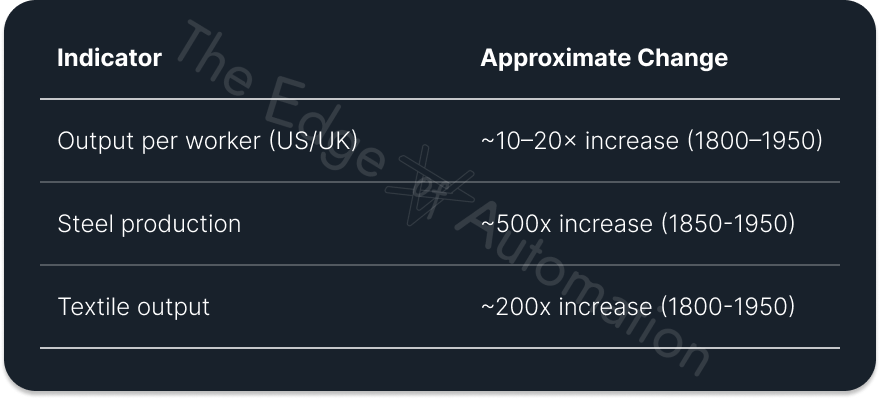
The industrial machine was the most productive servant in history – and the most dependent master.
Yet every machine of this era shared a defining constraint: it was a tool, not an agent. A tool amplifies what a human worker can accomplish; an agent completes a full cycle of work on its own. The steam engine multiplied the force a human could direct, but a human still decided where to direct it. Mechanical reapers accelerated the farmer’s output, but the farmer still had to operate them. No industrial machine could perceive its environment, adapt to variation, or execute a sequence of tasks without continuous human guidance. The intelligence, judgment, and decision-making that turned raw mechanical power into useful output remained entirely human.
Industrial machines mechanized brute force convincingly. Cranes hoisted loads no crew could lift. Presses stamped metal with pressures no arm could match. Locomotives hauled freight that would have taken wagon trains months to move. But the fine, dexterous manipulation that the majority of productive work actually required – assembling, sorting, fitting, adjusting, inspecting, repairing – stayed exclusively in human hands. No machine could thread a needle, position a rivet, or judge whether a finished part met specification by touch. Where force could be standardized and repeated, machines excelled. Where work demanded judgment and dexterity, humans remained irreplaceable.
The industrial revolution did not free humanity from labor. It made labor worth fighting over.
The industrial revolution delivered a transformative leap in productive capacity without precedent, replacing muscle with steam, craft with factory, and local production with integrated systems spanning continents. But the revolution’s deepest feature went largely unnoticed amid the output it generated. Every unit of this extraordinary new capacity still required human hands to function. Human labor sat at every critical node of the productive architecture, not as a residual input awaiting replacement but as the irreducible bottleneck through which all output flowed. The tool paradigm that defined the next two centuries was set: machines of immense power, utterly dependent on human workers.
II. The Productivity Ratchet
For most of human history, scarcity was not a problem to be solved but a condition to be managed. Food production set the ceiling: harvests determined how many people a territory could sustain, and any surplus was consumed by population growth before it could compound into lasting wealth. Supply chains were local, markets were thin, and abundance remained the exclusive province of a narrow band of elites. Civilization learned, across millennia, to calibrate its ambitions to what human hands could deliver, never outrunning that ceiling as there was no mechanism to do so. Labor supply held control, and scarcity was the baseline. The entire architecture of pre-industrial life was built around that fact.
The industrial revolution shattered that equilibrium. Mechanized farming and nitrogen-based fertilizers broke the Malthusian trap, catalyzing explosive population growth at rates that would have been lethal in prior centuries. Material goods once confined to aristocratic households reached ordinary families within a few generations. Each wave of prosperity raised the baseline of what society considered normal, and each new generation inherited that baseline as a floor rather than an achievement. Labor supply no longer set the ceiling; demand for output took over, driven by populations that neither understood nor cared how supply chains functioned. The ratchet had begun – once the world adapted to a higher standard of material life, retreat to the prior standard became socially and politically unthinkable.
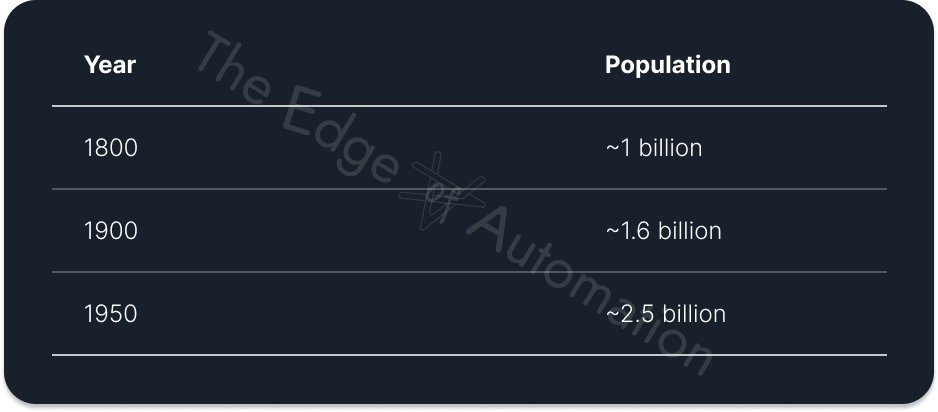
Supply chains broke free of geography. In the pre-industrial era, grain prices varied by as much as 10x between adjacent regions. Railroad integration collapsed that arbitrage and fused previously isolated local economies into a single continental price surface. Settlement followed – first along waterways, then rail lines, then anywhere automobiles could reach. Markets expanded, dependency relations multiplied nonlinearly, and the cost of upkeep scaled faster than the system itself. An integrated supply chain demanded far greater output to sustain than the sum of local chains it replaced: more edges in the dependency graph, each one a power relationship requiring active management. Complexity itself became a demand on output. The ratchet turned further.
Every new link in a supply chain is a promise that must be honored with output. Integration does not simplify; it multiplies the cost of standing still.
Supply chain integration at national scale made a new category of statecraft possible: the nation-state. Outside of China, state power rarely extended beyond the provincial level as supply chains could not carry authority further than they could carry goods. National integration let states exert power across entire territories through dependency networks. The Moltke-Bismarck unification project illustrates the mechanism precisely: it began not with armies but with railroad integration across the German states, giving Prussia economic leverage through dependency asymmetry before a shot was fired. Simultaneously, governments became responsible for popular welfare. Bismarck’s social insurance programs in the 1880s – pensions, accident insurance, health coverage – were not economic policy but a calculated strategy for national unity. Once those entitlements became citizenship rights, they created permanent output obligations the state could not shed. The ratchet turned again.
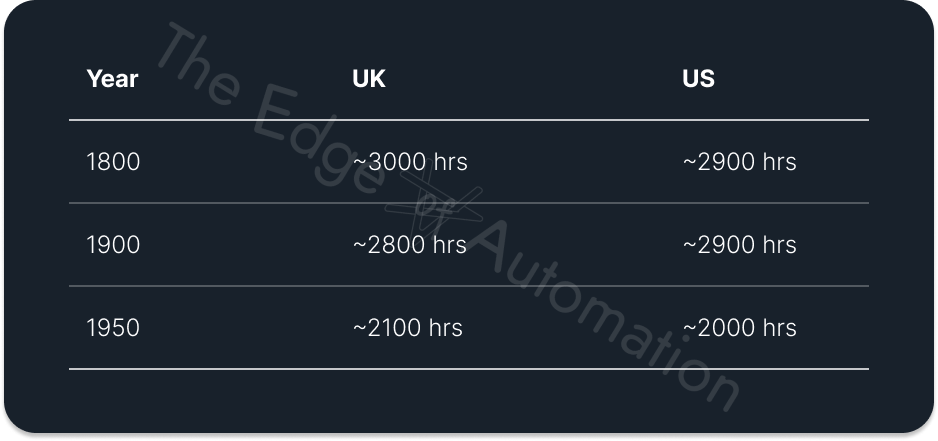
Civilization did not escape scarcity. It traded a ceiling it understood for a floor it could never lower.
National unification required breaking opposition by force. Every dynastic transition in China was a warlord struggle. The German Empire was declared at Versailles after defeating France in 1871 – the opening movement of a world accelerating toward total war. Nation-state wars operated at a scale prior eras could not have contemplated, leveraging integrated supply chains to mobilize millions while producing weapons, munitions, vehicles, and logistics at volumes that dwarfed anything peacetime industry had managed. Preparation fed the cycle – greater war capacity demanded higher output, which demanded deeper supply chain integration, which enabled greater war capacity. Each mobilization reset the production floor higher than the last. Output demand no longer grew gradually; it spiked in massive, discrete steps, and each spike became the new normal.
The ratchet locked in because the tool paradigm guaranteed it. Every industrial machine required human operation, so every expansion in productive capacity was simultaneously an expansion in demand for the hands that ran it. More factories meant more operators, more technicians, more logistics workers, more managers to coordinate the deepening web of interdependencies. Amplification without replacement meant civilization’s appetite for human work grew in lockstep with its appetite for output. No mechanism within the tool paradigm could break that cycle, as the only way to produce more was to ask more of human labor. The ratchet ran without interruption for over two centuries. By the mid-20th century, every structure of industrial civilization – its factories, its supply chains, its cities, its political commitments – rested on the assumption that this demand would continue to be met.
III. The Labor Elasticity Wall
For the first century of the industrial era, the labor supply held. Population growth across Europe and mass transatlantic migration gave the expanding economy a continuous top-up; whenever demand rose, new workers arrived to meet it. The assumption calcified into doctrine: labor was elastic, and the system could always stretch to accommodate whatever output civilization required. Then, within a single generation, that assumption broke. No single shock destroyed it. Multiple independent contraction vectors converged simultaneously, each reinforcing the others, none coordinated, none reversible. Together they built a wall that no amount of policy correction could dismantle.
The same wars that spiked output demand also destroyed the labor pools that sustained it. World War I killed 17 million people, disproportionately the 18–35 male cohort across Germany, France, and Britain; industrial heartlands lost their most productive workers in a single stroke. The U.S. Immigration Restriction Acts of 1921 and 1924 slashed annual intake from roughly 800,000 to 150,000, sealing the primary overflow valve at the precise moment demand was accelerating. The Great Depression compressed U.S. birth rates from 21 to 18.4 per 1,000, producing the thinnest working-age cohort in modern history exactly when postwar industry peaked. World War II then compounded the first: 70–85 million dead globally, two industrial-scale demographic shocks within 30 years.
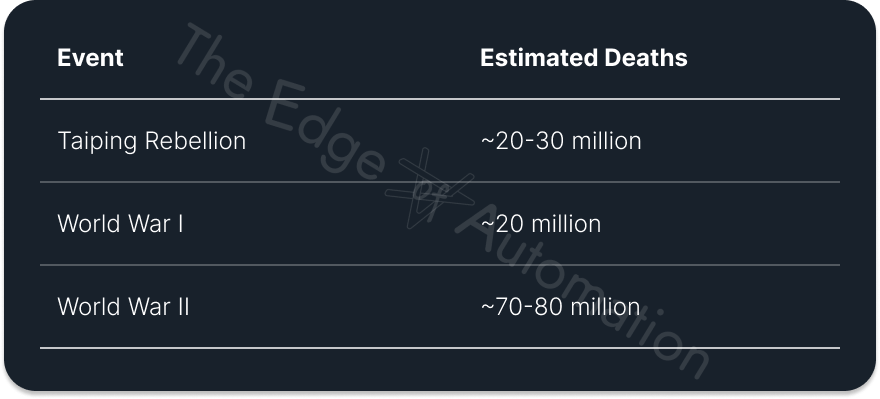
The contraction was not confined to the West. Across the world’s major civilizations, independent crises ran in parallel with no coordination and no common cause. In China, the Taiping Rebellion (1850–1864) killed an estimated 20–30 million people (5-10% of population), devastating the Yangzi Delta and triggering the civilization’s first genuine labor shortage since the Ming-Qing transition 3 centuries prior. In Indonesia, the Dutch Cultuurstelsel (1830–1870) locked roughly 25% of peasant households into forced export cultivation, removing them from productive market participation and preventing natural labor market formation across Southeast Asia. In India, famines under British administration between the 1870s and 1900s eliminated 12–29 million from the productive base at the peak of colonial extraction demand. Every major labor reservoir on Earth was shrinking on its own terms, in its own timeframe, for its own reasons.
A growing population can mask a shrinking workforce for decades. Complexity does not care how many people a nation has. It cares how many it can use.
Even as populations grew, the fraction that could be deployed declined. Early industrial output consisted of textiles, raw metals, and simple mechanical goods. By the 20th century, the global economy demanded automobiles, precision chemicals, electronics, and components built to tolerances invisible to the naked eye. Each generation of product required workers with higher skill and tighter coordination across longer sequences of interdependent tasks. Meiji Japan illustrated this problem. The samurai class, roughly 6% of the population, was stripped of hereditary roles in 1869 and rendered unemployable in a factory economy. Freed peasants lacked the mobility capital to reach urban industry, while universal male conscription pulled prime working-age men from textile mills at peak demand. Raw headcount had become an increasingly unreliable proxy for actual labor supply. Complexity transformed the kind of labor demanded.
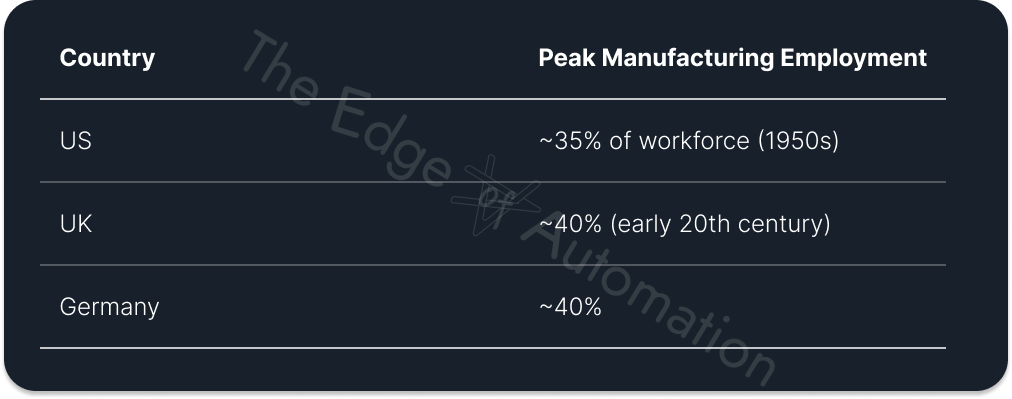
When domestic labor could not be replenished, civilization found its coping mechanism: move the factories to the workers. Western economies accelerated their shift from manufacturing to services, draining domestic industrial capacity further. Production consolidated into tightly integrated center-of-gravity states – Japan first, then South Korea and Taiwan, then China, which built vertically integrated supply chains within a single jurisdiction and commanded roughly a third of global manufacturing output by the early 21st century. The pattern was self-reinforcing: each round of consolidation made it harder for outsourcing nations to compete, drove more production offshore, and concentrated capacity into fewer hands. What began as firms seeking cheaper labor became a geopolitical restructuring that converted a labor problem into a sovereignty problem.
A nation that cannot manufacture does not have a trade deficit. It has a dependency.
The supply of human labor had hit an elasticity wall built from every direction at once. Wars cut absolute headcount. Immigration restrictions sealed the replacement valve. Depression-era birth troughs thinned future cohorts before they were born. Rising product complexity shrank the usable fraction from within. Consolidation concentrated what remained into a handful of states. For nations that had outsourced production, domestic manufacturing pools had atrophied beyond reconstitution: the factories were gone, the skills had evaporated, the supplier ecosystems had dissolved. For center-of-gravity states that absorbed the world’s output, even their massive labor reserves faced mounting strain as modern manufacturing began to outpace what human populations could deliver. No demographic intervention, wage increase, or market incentive could stretch the supply curve further. The industrial era’s labor foundation had entered irreversible decline.
IV. The Breaking Point
The productivity ratchet drove demand for human labor upward. The labor elasticity wall drove supply in the opposite direction. These were not parallel misfortunes but two halves of the same structural divergence, each compounding the other’s pressure with every passing decade. The gap between what industrial civilization required and what human labor could deliver widened year after year, and mechanism within the existing order could close it. This was not a cyclical downturn awaiting recovery, not a regional imbalance amenable to redistribution. It was a systematic deficit running through the foundation of the modern world itself.
An era that amplifies labor without replacing it does not approach equilibrium. It approaches collapse.
The symptoms appeared long before the diagnosis. Civilizations under labor deficit do not absorb the shortfall; they extract. At its industrial-era peak in Britain, roughly 1 in 5 workers was under 15. In textile mills during the 1830s, children constituted up to 40% of the workforce in some facilities. The deficit reached into demographics that no functional system would otherwise touch. The brutality of early factory conditions (14–16 hour shifts, 6-day weeks, systematic suppression of breaks) was not sadism but arithmetic: the only way to extract more output from a finite labor supply was to push each unit harder. The mass unemployment that the Luddites feared never materialized. Paradoxically, the problem was the opposite.
The deficit was not an accident of unfortunate demographics or misguided policy. It was physically inevitable from the moment the industrial revolution established the architectural foundation of this era: the tool paradigm. Because machines required humans to operate them, every productivity gain deepened civilization’s dependence on human labor rather than relieving it. The ratchet ensured that demand would always outpace supply. The elasticity wall ensured that supply could never catch up. These were not independent forces that happened to converge at an unlucky moment. They were consequences of the same root: an era built on machines powerful enough to amplify human labor but not capable enough to replace it. The industrial era was destined to reach this breaking point from the day of its birth.
Labor scarcity had constrained every civilization in history. But no prior civilization had built its entire architecture on the assumption that the constraint would never bind.
For two centuries, the entire civilizational architecture ran on an input it was progressively losing access to. The deficit accumulated like unpaid interest, each decade demanding more while receiving proportionally less. By the mid-20th century, it had compounded past the point of absorption. Outsourcing had converted supply chains into vulnerabilities. Consolidation had transformed a diffuse global problem into single-point dependencies that would fracture the moment center-of-gravity states hit their own demographic limits. The great reserves of untapped human labor that once absorbed each wave of expanding demand had been exhausted. For the first time in history, labor scarcity threatened not merely prosperity but the sustainability of civilization itself.
The deficit could no longer be absorbed by squeezing more from fewer workers or masked by the residual momentum of an era running on fumes. No government decree, corporate strategy, or social movement could resolve a constraint rooted not in any single input but in the foundational design of the era itself. Every factory floor, every supply chain, every sector that sustained the modern world ran through the same bottleneck, and no nation was exempt from the strain. The mandate was total: the survival of industrial civilization now required an alternative to human labor as the engine of productive capacity. This was not an aspiration waiting for the right technology to appear. It was a survival imperative imposed by 200 years of compounding pressure, and it would not wait for civilization to be ready.
Conclusion: The Shape of What Had to Come
The pre-autonomy era left behind a legacy more consequential than the abundance it created. The greatest expansion of output in human history simultaneously guaranteed that this world could not sustain itself without a source of labor that was running out. For 200 years, civilization ran on a widening deficit between what it demanded and what human hands could supply. The interest had compounded beyond what any human workforce could repay. The era was over – not because it had been transcended, but because it had exhausted the one resource it could never manufacture.
Abundance was the product. Dependency was the price. The era paid in full.
The nature of the crisis defined what would have to come next. The tool paradigm failed not because the machines lacked power but because they lacked agency – trucks, forklifts, locomotives, and conveyor belts could amplify productivity of workers, but could not perform a full cycle of work on its own. What civilization required was not stronger tools but a fundamentally different category of machine: an autonomous agent capable of perceiving its environment, adapting to variation, and executing sequences of tasks without a human operator at every node. The labor deficit had not merely created the mandate for a successor paradigm, but also carved the outline of the solution it demanded.
This article established that civilization needed an alternative to human labor as the foundation of productivity. But necessity does not wait for readiness. Labor scarcity continued to escalate, and history did not pause while technology matured or ecosystems formed. It forced action on whatever foundations were available, in whatever industry the pressure was most acute. The first era of autonomy (Level 1) would not be born from scientific ambition or engineering triumph. It would be extracted, under duress, from a civilization that had run out of room to defer.